March 11, 2006
Ontario Public Service Employees Union
Ontario, Canada
To All College Faculty Members Taking Job Action:
Public service workers throughout the world continue to be attacked by forces determined to create "cheap labour" and hegemony for "market forces."
Your members' collective refusal to retreat in the face of these attacks is an inspiration to workers everywhere.
In solidarity!
Korean Teachers Union
http://english.eduhope.net/
Saturday, March 11, 2006


Why is membership on the decline?
It's the start of a new school year, full of hope and promise. And of a dozen new teachers threatening and cajoling kids in classroom and hallway, only ONE is  . Thankfully, the ONE is an activist (I see him at the Incheon office, he does technical stuff) and he likes to drink.
It seems many teachers are simply not renewing their memberships when they transfer schools.
The members I talk to say it's an Image Problem. And while it's true that the Grand National Party and its allies in the unholy media triad are ruthless, reckless and relentless, the union simply doesn't have any coherent strategies designed to influence public opinion. Leaders have sit-ins and hunger strikes, but the union doesn't buy space on billboards, radio, or on websites! I've seen the budget, and NO funds are allocated for "public perception" agencies. (And of course, the "public" includes the rank-and-file.) It's no surprise we're taking a beating.
We at KTU like to praise "purity of intention" ... which is fine. But at the moment, parents have no idea what those intentions are.
I hope other team members will respond?
 . Thankfully, the ONE is an activist (I see him at the Incheon office, he does technical stuff) and he likes to drink.
It seems many teachers are simply not renewing their memberships when they transfer schools.
The members I talk to say it's an Image Problem. And while it's true that the Grand National Party and its allies in the unholy media triad are ruthless, reckless and relentless, the union simply doesn't have any coherent strategies designed to influence public opinion. Leaders have sit-ins and hunger strikes, but the union doesn't buy space on billboards, radio, or on websites! I've seen the budget, and NO funds are allocated for "public perception" agencies. (And of course, the "public" includes the rank-and-file.) It's no surprise we're taking a beating.
We at KTU like to praise "purity of intention" ... which is fine. But at the moment, parents have no idea what those intentions are.
I hope other team members will respond?
Wednesday, March 01, 2006
KTU Welcomes National Human Rights Commission Ruling on Temporary Teachers
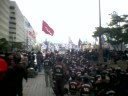
Nearly 40 percent of all education workers in urban middle and high schools are irregular workers
http://english.eduhope.net/news/park010306.htm
As I (and of course all foreign teachers) belong to that 40%, it's good to see the NHRC bringing attention to a few of the ways irregular workers in education are being screwed around. And though I'm glad the union is paying attention, I'm far from grateful, as it could be doing a lot more for 'temporary' teachers.
Hannara Party Encourages Students to Report Progressive Teachers

Too absurd for comment, really. A marginally cooler GNP head must have seen the board, because it wasn't up for long.
http://english.eduhope.net/news/hwang180206.htm
Tuesday, February 21, 2006
To the New Teacher: Join the Fucking Union
So you're a teacher, prepared with social and cognitive learning theories and pedagogical techniques, and determined to inspire young minds with your wisdom and wit.
What they perhaps didn't teach you at Gyeongin University, but is obvious if you read the paper or watch the news, is that your new profession is under attack: we are told teachers are "irresponsible," "selfish," "incompetent." That's fine, you might think, I'm prepared to put up with this, I know how important the job is, I will maintain a noble posture under fire.
If only it were so simple, that it were a matter of individual teachers persevering! For it's not only you and your profession that is being attacked, but the entire structure of publicly-funded education itself, upon which you stand, that is being attacked, undermined, constantly. And, foundations weakened, it's beginning to sway.
Don't feel it yet? To an outsider, the proliferation of hagwons, and legion of private tutors, in this country speaks very plainly that public education isn't working. And look at the new free economic zones, and now the new 'charter schools.' This is the trend--this is the future that is being prepared, with careful intent and ideological zeal: allow publicly-administered education to deteriorate, and let the companies move in, to pilfer resources and scoop up the most advantaged students.
Parents know that things are bad, and of course they blame teachers. As they should.
But perhaps you protest here--I'm only a public servant, I must remain neutral! And if you really believe this, you deserve parents' blame. Parents don't care what your ideals are. They know that their children are not getting the education they need at school. They feel that your first responsibility is to the children you teach, not your employer the state that is abandoning the most vulnerable of its citizens (the kids in Gangnam will be fine regardless, thank you).
In 1966 UNESCO made a number of recommendations concerning the status of teachers and the teaching profession. Perhaps you learned of these in university? UNESCO recommended, among other things, that teachers be allowed to form professional organizations in member countries. By professional it means self-regulating, self-governing. Teachers decide who will be teachers, and teachers decide who is promoted, and disciplined. Countries that are serious about education follow the recommendations--for who better understands education than teachers? And the experts who drafted the recommendations understood that education would always need passionate advocates, and that organizations of professionals would serve this function.
This is why, in Canada, any time a conservative government attempts to cut funding to education, teachers organize to defend it, to remind parents and media of how essential it is. Of course when teachers must strike, when schools are empty and parents are struggling to find people to care for their young children, the government and conservative media outlets call teachers "selfish" and "irresponsible." This is inevitable. Teachers know what they're doing is important.
Koreans spend more money on education than the people of any other UNESCO country. If teachers had the resolve, Korea's education system could rival that of Denmark or Norway. Unfortunately, it appears that Korea will soon have a system that resembles that of the Philippines. Unless teachers organize.
Your silence, your noble posturing, means complicity, and nothing more.
UNESCO Recommendation Concerning the Status of Teachers
What they perhaps didn't teach you at Gyeongin University, but is obvious if you read the paper or watch the news, is that your new profession is under attack: we are told teachers are "irresponsible," "selfish," "incompetent." That's fine, you might think, I'm prepared to put up with this, I know how important the job is, I will maintain a noble posture under fire.
If only it were so simple, that it were a matter of individual teachers persevering! For it's not only you and your profession that is being attacked, but the entire structure of publicly-funded education itself, upon which you stand, that is being attacked, undermined, constantly. And, foundations weakened, it's beginning to sway.
Don't feel it yet? To an outsider, the proliferation of hagwons, and legion of private tutors, in this country speaks very plainly that public education isn't working. And look at the new free economic zones, and now the new 'charter schools.' This is the trend--this is the future that is being prepared, with careful intent and ideological zeal: allow publicly-administered education to deteriorate, and let the companies move in, to pilfer resources and scoop up the most advantaged students.
Parents know that things are bad, and of course they blame teachers. As they should.
But perhaps you protest here--I'm only a public servant, I must remain neutral! And if you really believe this, you deserve parents' blame. Parents don't care what your ideals are. They know that their children are not getting the education they need at school. They feel that your first responsibility is to the children you teach, not your employer the state that is abandoning the most vulnerable of its citizens (the kids in Gangnam will be fine regardless, thank you).
In 1966 UNESCO made a number of recommendations concerning the status of teachers and the teaching profession. Perhaps you learned of these in university? UNESCO recommended, among other things, that teachers be allowed to form professional organizations in member countries. By professional it means self-regulating, self-governing. Teachers decide who will be teachers, and teachers decide who is promoted, and disciplined. Countries that are serious about education follow the recommendations--for who better understands education than teachers? And the experts who drafted the recommendations understood that education would always need passionate advocates, and that organizations of professionals would serve this function.
This is why, in Canada, any time a conservative government attempts to cut funding to education, teachers organize to defend it, to remind parents and media of how essential it is. Of course when teachers must strike, when schools are empty and parents are struggling to find people to care for their young children, the government and conservative media outlets call teachers "selfish" and "irresponsible." This is inevitable. Teachers know what they're doing is important.
Koreans spend more money on education than the people of any other UNESCO country. If teachers had the resolve, Korea's education system could rival that of Denmark or Norway. Unfortunately, it appears that Korea will soon have a system that resembles that of the Philippines. Unless teachers organize.
Your silence, your noble posturing, means complicity, and nothing more.
UNESCO Recommendation Concerning the Status of Teachers
Saturday, February 18, 2006
The End of Public Education?
The Chosun Ilbo reports ministry plans to fund "charter schools," starting next year.
Never mind that public funds will pour into places where the public is not welcome, and never mind that charter schools often under-perform public schools in the U.S.
It's pretty clear what's happening in Korean education: public schooling is to be allowed to deteriorate further, so that independent, for-profit companies will be welcomed in, to pillage resources and suck up the children of the upper and middle classes. And with "international schools" in the 'free' economic zones opening soon, a three- or four-tier education system, and a brave new republic.
Wealthy enough to emulate a system like Denmark's, Korea will end up with a system like the Philippines'. Nicely done.
Never mind that public funds will pour into places where the public is not welcome, and never mind that charter schools often under-perform public schools in the U.S.
It's pretty clear what's happening in Korean education: public schooling is to be allowed to deteriorate further, so that independent, for-profit companies will be welcomed in, to pillage resources and suck up the children of the upper and middle classes. And with "international schools" in the 'free' economic zones opening soon, a three- or four-tier education system, and a brave new republic.
Wealthy enough to emulate a system like Denmark's, Korea will end up with a system like the Philippines'. Nicely done.
Tuesday, February 07, 2006
the Free Teachers Union?!
What is the Dong-A Ilbo talking about? "A new teachers’ union opposing the Korean Teachers and Education Worker`s Union (KTU) will be launched in March."
Wishful thinking? Agit-prop? Somebody fill me in?
Wishful thinking? Agit-prop? Somebody fill me in?
How to globalize the labour movement?
A good entry to the Global Labor Strategies blog. Unfortunately, most KTU membership has never heard of Education International, still the best vehicle for building knowledge and solidarity networks across borders.
Calling all English-using members: Promote EI! Translate stuff that interests you for KTU media!
Calling all English-using members: Promote EI! Translate stuff that interests you for KTU media!
Thursday, February 02, 2006
This is the Uri government.
The Ministry of Government Administration and Home Affairs tells public service workers that their decision to join the KCTU is "illegal": "its collective action of voting is not allowed," said Lee Doo-pyo, an official with the ministry.
They are petulant children, stamping their feet and pouting when people don't listen to them. The KTU response is here.
Find some dignity, gentlemen. You're embarrassing your country.
They are petulant children, stamping their feet and pouting when people don't listen to them. The KTU response is here.
Find some dignity, gentlemen. You're embarrassing your country.
Tuesday, January 24, 2006
Don't sing the Alphabet Song - you'll confuse the kids!
My first entry, and I use it to question the union's position on ministry plans to introduce English at the first year of primary education.
As the committee points out, it's true that the ministry of education didn't consult parents or teachers before announcing its plans. After decades (centuries?) of dictatorship, bureaucrats here aren't much in the habit of asking people for their opinions on policy measures.
. . . Knots, thorns, choose your simile, language policy in ROK is a complex issue. The government banned private tutoring because parents were spending "up to 90% of their disposable income" buying input from expert English speakers. Don't blame parents: when the city of Seoul begins conducting job interviews in English, there's no need to jab a wet finger in the air to know what's coming. The gatekeepers have a new lock to be picked.
But the committee's claim that earlier access to English in primary schools will cause "more inequality in education" is difficult to accept. This implies that the ministry of education is responsible for the country's obsession with English, which is nonsense. Or so it appears to this observer. It seems to me that the ministry is simply responding to the demands of universities and employers.
Indeed, it can be argued that this move will reduce inequality. After all, most parents simply cannot afford to send their children abroad for two years; and those first-graders who are to be shipped to Seattle or Sidney really won't need that hour of English they'll get in class every week.
What the committee doesn't say, and what every elementary school teacher knows, is that there simply aren't enough people in schools with the language skills necessary to instruct all these kids. The ministry hopes that teachers will somehow, from somewhere, acquire these skills over the next few years, without it having to invest the kind of money that such extensive training would require.
(And while the release does suggest a wariness of certain hegemonic forces, and the urge to take protective measures against these, I won't explore this now.)
A public education should prepare kids for meaningful, active, and creative participation in the spaces they will find themselves in when they graduate. If the country's schools were adequate, parents wouldn't feel the need to spend so many millions of won on private instruction. Teachers must organize, and demand that the government invest in public education, before the market swallows it.
Subscribe to:
Posts (Atom)
